
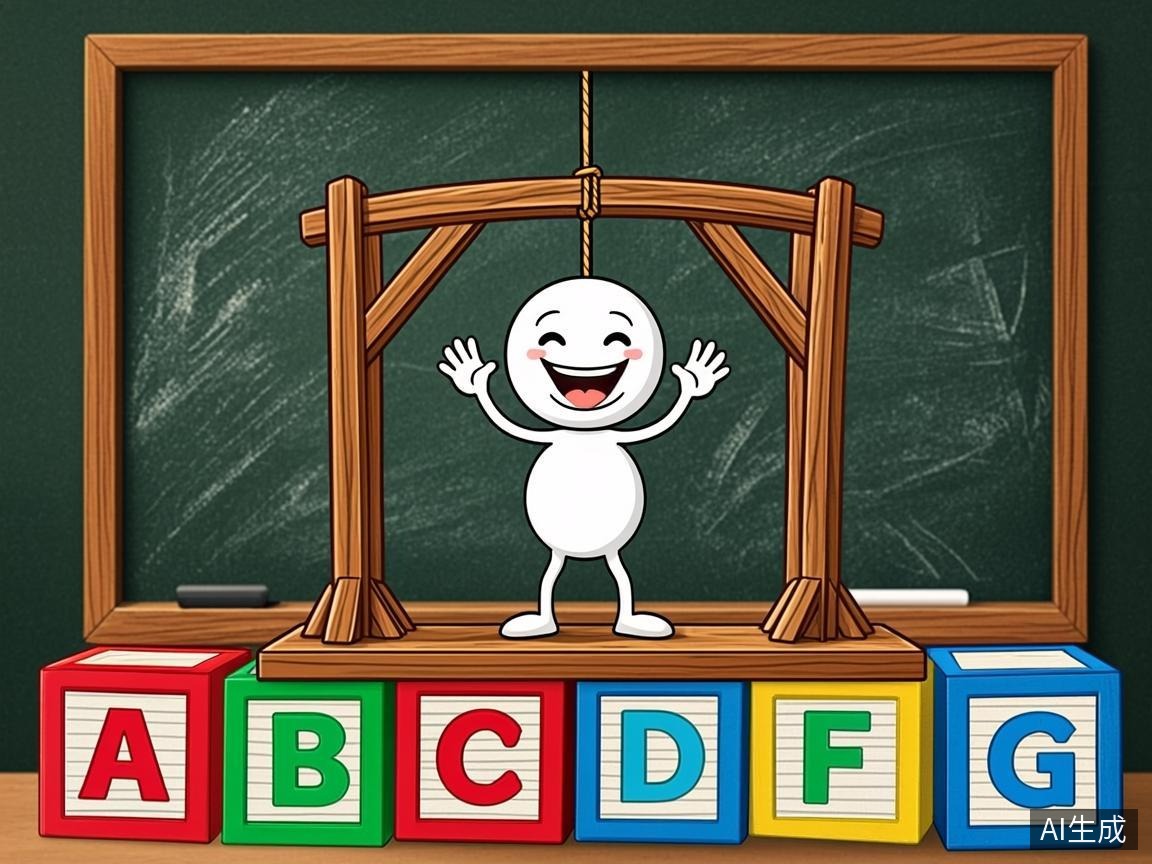
Hangman
Guess the hidden English word letter by letter!
📚 Why Hangman Is Great for Learning English
Hangman is one of the best word games for building English vocabulary and spelling skills. When you guess letters to reveal a hidden word, your brain actively recalls spelling patterns and word structures. This process strengthens memory and helps you recognize common letter combinations in English. Each round introduces a new word, and the category hints guide your thinking. You naturally learn about animals, food, nature, and more while having fun. The challenge of guessing before running out of tries makes every letter feel important. Studies show that playful word games improve vocabulary retention far better than passive reading. So pick your letters carefully, learn new words, and enjoy the game!
🎮 How to Play
- A secret English word is hidden. Pick a category to begin.
- Click or type letters to guess the word. Correct letters appear in the blanks.
- Each wrong guess adds a part to the hangman. You have 6 chances!
- Use the Hint button to reveal one letter (costs points).
- Guess the word before the hangman is complete to win!
Hangman: The Classic Word Game That Teaches Real Spelling Skills
Why letter-by-letter guessing is one of the most effective ways to build spelling and vocabulary — from a teacher with over a decade of classroom experience.
Why Hangman Is More Than Just Guessing
I have been teaching English for more than ten years, and Hangman is one of those rare games that never loses its power. Students love the suspense and the moment when the final letter clicks into place. But what keeps me coming back to it is what happens underneath: every round forces the brain to search through stored vocabulary, evaluate letter patterns, and make strategic decisions. That is genuine language processing, not passive recall.
The core skill Hangman teaches is spelling-through-deduction. When a student stares at a row of blanks and thinks, “What five-letter animal has an E in the second position?” they are engaging with word structure at a deep level. They are investigating a word from the inside out, not reciting a spelling list. Game-based learning works here because it pairs cognitive effort with emotional stakes. The countdown of wrong guesses makes every letter choice feel meaningful, and that engagement cements learning in ways worksheets cannot. Students develop sharper word recognition, stronger phonics instincts, and genuine confidence when they crack a difficult word.
Learning Objectives
When I plan a lesson around Hangman, these are the outcomes I target:
- Spelling improvement — Students test spellings against visible letter positions, reinforcing correct sequences through trial and error.
- Vocabulary retention — The effort of guessing a word makes it far more memorable than simply reading it.
- Word recognition — Recognizing partial words from limited clues trains faster identification in reading.
- Phonics and letter patterns — Students learn which consonant clusters and vowel combinations are likely in English.
- Critical thinking — Choosing which letter to guess requires analysis of word length, category, and remaining possibilities.
- Communication skills — In group play, students discuss strategies and justify letter choices aloud in English.
How the Game Works
The screen shows a row of blank spaces representing a hidden English word. Before guessing, the player selects one of four categories — Animals, Food, Nature, or School — which provides a context clue. Then they click or type letters one at a time. Each correct letter fills in every instance of that letter in the word. Each wrong guess adds a body part to the hangman figure. Players get six wrong guesses before the round ends.
A Hint button reveals one letter at the cost of points, teaching students when to seek help versus trust their own thinking. The game tracks score, win streak, and total wins. Consecutive correct guesses build the streak, which is surprisingly motivating. Each category pulls from a large word bank, giving excellent replay value. Winning means guessing the full word before running out of chances, but the real achievement is the growing sense that English words are puzzles you can solve.
English Concepts Explained
This is the section that matters most, because understanding why Hangman works is what turns it from a time-filler into a genuine teaching tool.
Spelling Patterns and Common Letter Combinations
English is not random. Certain letter combinations appear far more frequently than others, and Hangman teaches students to recognize these patterns intuitively. After a few rounds, students start guessing common pairs like TH, CH, SH, and vowel digraphs like EE and OA without being told to. I often pause mid-game and ask, “Why did you choose T?” When a student replies, “Because most long words have a T somewhere,” they demonstrate genuine spelling awareness that no worksheet taught them.
Vocabulary Acquisition Through Active Retrieval
The principle at work is retrieval practice. When a student guesses a word from partial information, they pull vocabulary from memory rather than simply recognizing it on a page. That effort strengthens the memory trace dramatically. Words my students guess in Hangman show up in their writing weeks later, whereas words they merely read in a textbook tend to fade. The struggle to find the answer is what makes it stick.
Context Clues and Category-Based Thinking
The four categories teach students to use contextual constraints. If the category is “Animals” and the word has five letters, the brain narrows from thousands of possibilities to a manageable set: horse, tiger, sheep, snake. This is the same skill they need when encountering unfamiliar words in reading — use surrounding context to narrow meaning. Hangman trains that habit in a low-stakes format.
Phonics and Pronunciation Awareness
One thing I like to do is require students to say each letter sound aloud before clicking. If the word is “dolphin” and a student chooses D, they must say the sound /d/ first. This adds a phonological layer to a visual game, strengthening the connection between spelling and pronunciation that is so critical for English learners.
Word Structure and Morphological Awareness
Longer words often contain suffixes and prefixes that students learn to spot. When they see a word ending in “-ing,” they start volunteering common verb stems. When it ends in “-tion,” they anticipate nouns. This morphological thinking — breaking words into meaningful parts — supports both spelling and reading comprehension, and Hangman teaches it without explicit instruction.
Difficulty Levels and How to Use Them
Beginner (Short Words, Generous Hints)
For beginners, I stick to short words in Animals and Food. Three- to five-letter words give new learners a realistic chance. I encourage using the Hint button freely at first — it is better to win with help than to lose and feel defeated. Playing the same category several times builds a cluster of related vocabulary that reinforces itself.
Intermediate (Longer Words, No Hints)
Intermediate students are ready for six- to eight-letter words across all categories. At this level, I introduce a no-Hint rule. Forcing students to rely on their own knowledge pushes strategic thinking about vowel placement and common consonants. I also ask them to explain their reasoning after each guess, turning a solo game into a metacognitive exercise.
Advanced (Challenge Mode and Extensions)
I challenge advanced students to guess words in the fewest possible letters — three or fewer wrong guesses per round. After winning, they must use the word in a sentence, define it, or identify its part of speech. These extensions push learners from recognition to active production, the gap where many language learners stall.
Real Learning Benefits
Hangman exercises working memory in a uniquely effective way. Students hold multiple pieces of information simultaneously: revealed letters, guessed letters, category constraints, and candidate words. That cognitive juggling strengthens the memory systems that support reading and writing. The game also builds active recall — students who regularly retrieve information from memory retain it up to fifty percent longer than those who simply reread. Beyond memory, it develops focus and concentration, because losing attention for one letter can mean the difference between winning and losing. And because students track their own streaks, they experience measurable progress that builds authentic confidence.
Teacher Tips
I like to use Hangman as a five-minute warm-up. I project it on the board, pick a word related to that day’s lesson, and let the whole class guess together. It activates prior knowledge before I even introduce the topic. One strategy that works well in my classroom is pair play on shared devices, with students explaining their letter choice before clicking. The conversations I overhear during these sessions are rich with reasoning and vocabulary.
For revision, I run a weekly Hangman tournament using words from that week’s vocabulary list. Students compete for the longest streak. The competitive energy keeps everyone engaged, and the repeated exposure reinforces the words before the weekend. As homework, I assign five rounds in a specific category before a writing task — it primes the vocabulary they need. For differentiated instruction, struggling learners use shorter words and hints, while advanced students face limited wrong guesses and sentence-writing extensions. The game meets every learner where they are.
Parent Guide
The best thing you can do at home is play alongside your child. When they hesitate, ask what they are thinking: “What sound comes after S-H?” That simple question turns screen time into a learning conversation. You do not need all the answers — just asking deepens their thinking.
For screen-time balance, fifteen to twenty minutes per session for younger children and up to thirty for older students works well. The categories create natural breakpoints. Encourage effort over results: if your child loses a round, focus on what they did right. “You guessed four out of six letters — great thinking!” That encouragement builds the resilience they need to keep trying with difficult words.
Frequently Asked Questions
What age group is Hangman best for?
It works well from age six through adulthood. Younger children benefit from Animals and Food with shorter words, while older students challenge themselves across all categories.
How does guessing improve spelling?
Effective guessing is not random — players test letters based on spelling patterns and word structure. Each guess requires mentally generating and evaluating possible spellings, strengthening the internal model of how English words are built.
Should my child use the Hint button?
Yes, especially at first. It reduces frustration and keeps the game enjoyable. As confidence builds, encourage playing without hints. The gradual shift from supported to independent guessing mirrors good classroom instruction.
Can Hangman be played in a group?
Absolutely. Project it on a screen and let students take turns. Group play generates discussion about letter choices and possible words, turning a solo game into collaborative language practice.
Is Hangman suitable for ESL students?
Excellent for ESL learners. Category clues provide essential context, and the letter-by-letter format engages with English spelling in a way that feels like a puzzle rather than a test. I use it regularly from A1 to B2 levels.
Related Games
If your students enjoy Hangman, these games offer complementary English-learning experiences:
- Memory Match – English Word Game — Build vocabulary through picture-word matching and visual memory.
- Speed Math – Fun Math Learning Game — Develop quick thinking with timed arithmetic challenges.
- Doodle Pad – Digital Whiteboard for Creative Learning — Practice labeling and descriptive writing through drawing.
Ready to watch your students’ spelling confidence grow, one letter at a time?
Play Hangman NowFree to play • No sign-up required • Works on any device
Spelling Vocabulary Word Game Phonics English Learning ESL Letter Patterns
Table of Contents
Toggle






Leave a Reply