
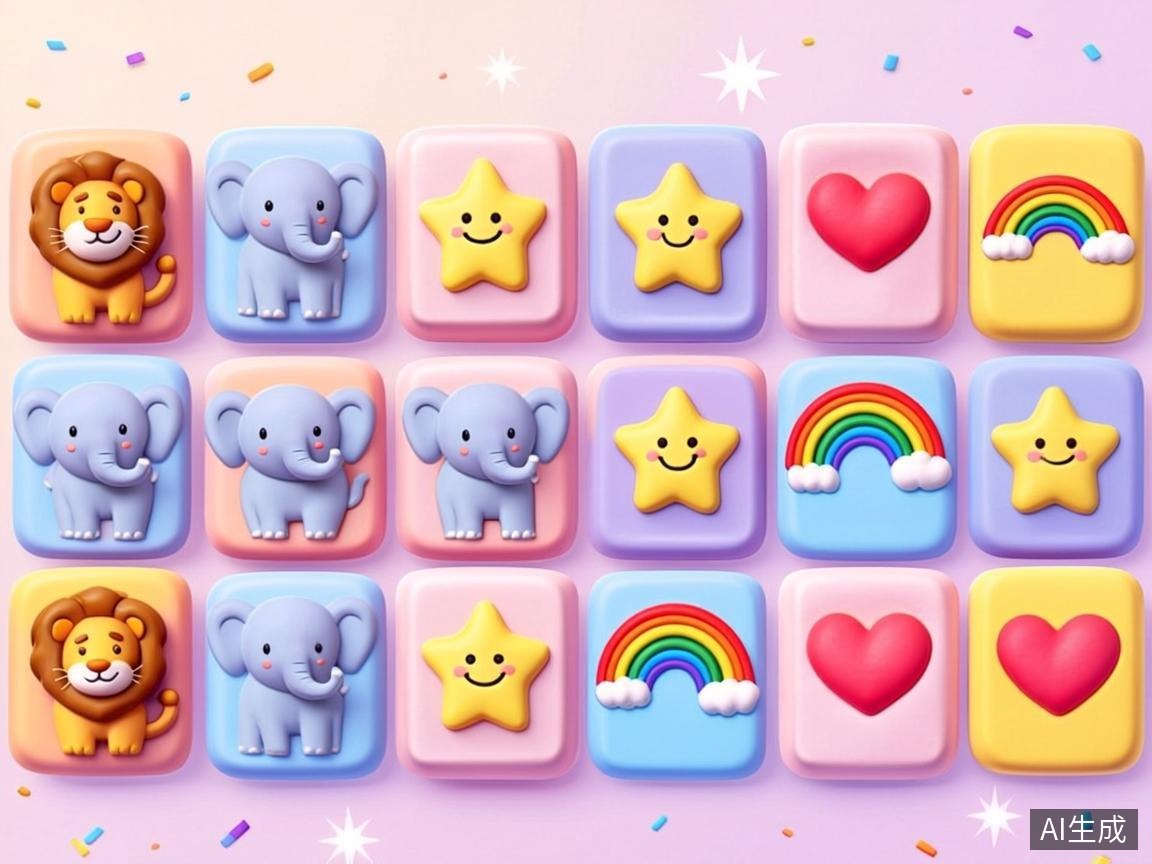
Memory Match
Match English words with pictures and boost your vocabulary!
📚 How Memory Games Help You Learn English
Memory match games are one of the best ways to learn new English words. When you flip cards and search for matching pairs, your brain builds strong connections between pictures and words. This visual matching technique helps you remember vocabulary much faster than simply reading a list. Each round challenges your short-term memory while reinforcing word recognition. Studies show that playful learning activates multiple areas of the brain, making new words stick with you longer. So have fun, challenge yourself, and watch your English vocabulary grow with every game!
🎮 How to Play
- Tap any card to flip it over and reveal a picture or English word.
- Tap a second card to try to find its match (picture + word).
- If the two cards match, they stay face-up and you earn points!
- If they don’t match, they flip back. Try to remember where they are!
- Find all pairs to win. Use fewer moves for a higher score!
Memory Match: The English Vocabulary Game That Actually Works
How picture-word matching builds real language skills — from a teacher who has used it for over a decade.
Why Memory Match Is More Than Just a Game
I have been teaching English for over ten years, and one thing I have learned is that students remember words best when they connect them to something visual and interactive. Memory Match does exactly that. It presents a grid of face-down cards, each hiding a picture or its matching English word. Flip two cards at a time and find the pairs. Beneath that simple mechanic lies a genuinely powerful vocabulary-building tool.
The skill this game teaches — rapid word-picture association — mirrors how we naturally acquire language. When a child learns their first word, they see an object, hear its name, and form a mental link. Memory Match recreates that digitally. Game-based learning works because it combines repetition with emotional engagement, something flashcard drills cannot match. Students develop sharper focus, quicker recall, and genuine confidence. I have watched quiet students light up when they beat their own record, and that motivation carries into everything else we do.
Learning Objectives
When I build a lesson around Memory Match, these are the outcomes I am targeting:
- Vocabulary retention — Students encounter each word multiple times across rounds, embedding it in long-term memory.
- Spelling improvement — Seeing the written word repeatedly while searching for its match reinforces correct letter order naturally.
- Word recognition — The speed element trains students to identify words at a glance, a foundational reading fluency skill.
- Reading fluency — Faster word recognition translates directly to smoother reading elsewhere.
- Critical thinking — Deciding which cards to flip requires strategy and spatial memory.
- Communication skills — In pair play, students discuss strategies and verbalize their thinking in English.
How the Game Works
The game board displays cards arranged in a grid, all face-down. A student taps any card to flip it, revealing either an illustration or an English word, then taps a second card. If the picture and word form a correct pair — a drawing of a dog and the word "dog," for instance — both cards stay face-up and the student earns points. If they do not match, they flip back and the student must remember where each one was.
The game tracks score, moves, and elapsed time. Fewer moves mean a higher score, encouraging memory over guessing. Three difficulty levels are available: Easy uses six pairs, Medium uses eight, and Hard presents ten. Completing a level unlocks the next one, and the "New Words" button shuffles in fresh vocabulary, giving enormous replay value. Find every pair to win. But the real win is internal — students notice they are remembering words faster and recognizing vocabulary they once struggled with.
English Concepts Explained
This is the section I care about most, because understanding the language mechanics behind the game is what turns screen time into genuine learning.
Vocabulary Acquisition Through Dual Coding
Memory Match is built on a principle called dual coding. When information enters the brain through two channels — a visual image and a written word — it creates two memory traces rather than one, giving students two pathways to retrieve the word later. I often ask my classes how they remember the word "sun." Most picture something bright and warm before the letters appear. Memory Match trains that instinct with every vocabulary set.
Spelling Patterns and Word Recognition
Because students see the written form while actively searching for a match, spelling becomes something they absorb rather than study. After a few rounds, my students consistently spell target words more accurately on quizzes. They engaged with each word in a goal-oriented context — trying to find a match, not memorize spelling. That shift changes how the brain stores the information, turning the word from abstract letters into a meaningful label.
Context Clues and Meaning-Building
The pictures serve as powerful contextual anchors. When a student sees an illustration of a river beside the word "river," the image provides immediate semantic context — the picture is the definition. For beginner and elementary learners, this visual-first approach removes the frustrating barrier of needing other words to understand a new word.
Phonics and Pronunciation Awareness
One strategy I use is having students say each word aloud when they flip its card. When a student says "elephant" while looking at the picture and the word, they engage three channels simultaneously: visual, written, and auditory. That three-way reinforcement is potent for long-term retention and gives me a natural opportunity to correct pronunciation in a low-pressure setting.
Parts of Speech Awareness
The vocabulary spans multiple parts of speech — nouns like "banana," adjectives like "happy," and verbs like "run." I pause after a round and ask students to sort matched words into categories: person, place, or thing for nouns; action words for verbs; describing words for adjectives. This simple extension transforms a matching game into a grammar lesson with almost no extra preparation.
Difficulty Levels and How to Use Them
Beginner (Easy — 6 Pairs)
I start every new group on Easy mode. With only six pairs, the cognitive load is manageable and students succeed quickly. For beginners, success is everything. I recommend letting them play the same word set multiple times before moving on. Repetition at this stage is not boring — it is essential.
Intermediate (Medium — 8 Pairs)
Once a student clears Easy mode in under twelve moves consistently, they are ready for Medium. The two extra pairs significantly increase the memory demand. One adaptation I like: ask students to write down each new word before flipping the next card, forcing them to process the spelling rather than relying on visual recall alone.
Advanced (Hard — 10 Pairs)
Ten pairs is a genuine challenge, reserved for students with a solid foundation. After completing a round, I ask them to use at least five matched words in original sentences. This pushes them from recognition to production — a critical step in language acquisition that many games overlook.
Real Learning Benefits
Each round exercises working memory as students hold card positions in their mind while scanning for matches. This active recall is one of the most effective study techniques identified by cognitive science — students who practice it regularly retain information up to fifty percent longer than those using passive methods like rereading.
I have also seen real improvements in focus. The game demands sustained attention because losing focus for even one turn means forgetting a card location. Over time, this trains the brain to maintain attention longer — a skill that transfers to reading and test-taking. Most importantly, the game fosters independent learning. Students play on their own, track their progress, and set goals. That autonomy builds genuine confidence.
Teacher Tips
I like to use Memory Match as a lesson opener when introducing a new vocabulary unit. I give students five minutes to play, then ask which words they already knew and which were new. That quick diagnostic tells me exactly where to focus my instruction.
One strategy that works well in my classroom is pair play. Two students share one screen and take turns, but before each turn the player must describe what they are looking for in a full sentence. Instead of just clicking, they might say, "I am looking for the word that means a large body of water." This turns a solitary game into a rich speaking activity.
For revision, I run weekly Memory Match tournaments where students compete to clear the board in the fewest moves. The competitive element raises energy, and the repeated vocabulary exposure cements it in memory before the weekend. For differentiated instruction, the game is a gift — struggling students stay on Easy until ready, while advanced students jump to Hard and extend with sentence writing. It differentiates itself.
Parent Guide
The most helpful thing you can do at home is sit with your child for a few rounds and talk about the words. When they see "butterfly," ask them to describe one. These conversations deepen the learning far beyond the screen. You do not need to be an English teacher — just being curious makes a real difference.
I recommend fifteen to twenty minutes per session for younger children, thirty for older students. The built-in levels create natural stopping points. Encouragement matters more than correction. If your child mispronounces a word, model the correct form naturally. If they say "ban-ana-na," respond with "Oh, banana! Yes, I saw the banana card too." They will self-correct over time without feeling judged.
Frequently Asked Questions
What age group is Memory Match best suited for?
It works well for ages five and up, and I have also used it with adult learners. Younger children thrive on Easy, while older students find Hard appropriately challenging. The vocabulary sets cover a wide range, so there is always something new to learn.
How many words can my child learn from this game?
Each round introduces six to ten words. The "New Words" feature refreshes the set, so students encounter dozens in a session. Over a week of regular play, retaining twenty to thirty new words is very achievable.
Is Memory Match effective for students who struggle with spelling?
Absolutely. It exposes students to correct spelling repeatedly in a low-stakes context. This passive, repeated exposure often improves spelling more effectively than drills because the brain stores the word as a whole visual unit.
Can Memory Match be used in a classroom with multiple students?
Yes. Project it on a whiteboard and have students take turns as a group. Pair play on a shared device works well too. For larger classes, set up stations where small groups rotate through the game alongside other activities.
How is this different from just using flashcards?
Flashcards are passive — students flip and read. Memory Match requires active searching, remembering positions, and making strategic decisions. That cognitive load strengthens memory formation and keeps students motivated longer. The scoring system also provides instant feedback that flashcards cannot.
How long should a play session last?
I recommend ten to twenty minutes. The rounds are short enough to complete several, but not so long that attention wanders. Multiple short sessions across the week are far more effective for retention than one long session.
Related Games
If your students enjoy Memory Match, these games offer additional English-learning opportunities:
- Hangman - English Word Guessing Game — Practice spelling and letter recognition by guessing hidden words.
- Speed Math - Fun Math Learning Game — Build number fluency with timed arithmetic challenges.
- Doodle Pad - Digital Whiteboard for Creative Learning — Combine drawing and labeling for hands-on vocabulary practice.
Ready to see your students' vocabulary grow with every flip?
Play Memory Match NowFree to play • No sign-up required • Works on any device
Vocabulary Word Recognition Spelling Memory Game English Learning ESL Picture-Word Match
Table of Contents
Toggle




Leave a Reply